
LEARNING CENTER · Sump & Drainage
How much does it cost to replace a sump pump in Louisville?
The short answer
Replacing an existing sump pump in Louisville runs about $800–$900 for a 1/3 HP unit to $900–$1,000 for a 1/2 HP. Adding a battery backup runs about $2,200–$2,400. A water-powered backup is less, about $1,200–$1,400. Digging a brand-new pit is a bigger job, closer to $4,800–$5,000.
If your basement smells like a wet penny after every hard rain, your sump pump is either working overtime or already dead. Replacing one in Louisville isn't a mystery-priced job. A straight swap of an existing pump runs between about $800 and $1,000, and we'll walk through what moves that number. The bigger cost questions are usually the backup system and whether there's already a pit in your floor to drop a pump into.
What replacing a sump pump costs
- 1/3 HP replacement About $800–$900. The workhorse for a dry-to-average Louisville basement. New pump dropped into your existing pit, usually a same-day swap.
- 1/2 HP replacement About $900–$1,000. The stronger motor clears more water faster, which matters when your pit fills quick during a spring downpour. It's our most common swap.
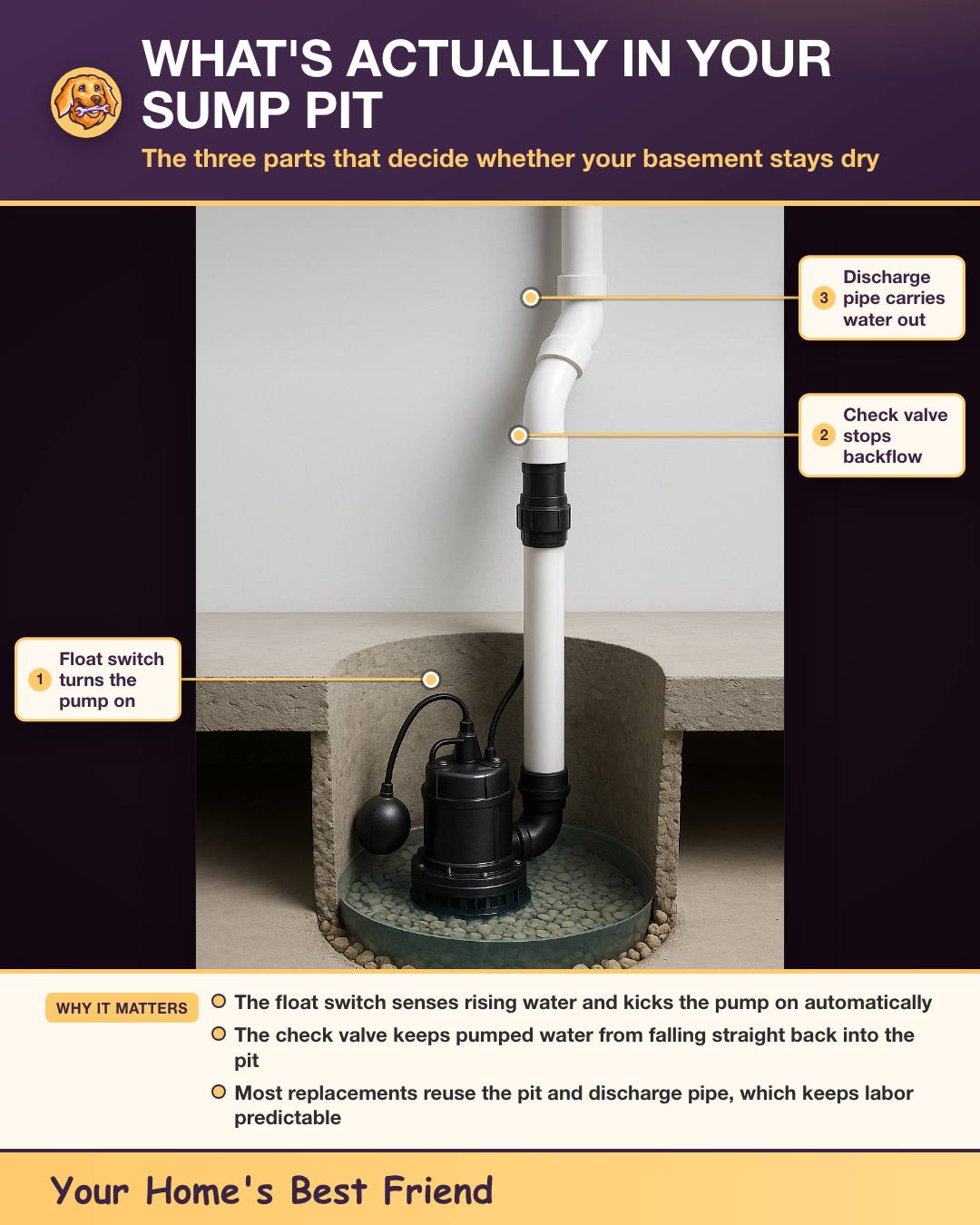
- Replacement with a new check valve About $900–$1,000. If your check valve is worn, water drains back down the pipe after every cycle and the pump short-cycles itself to death. We swap the valve with the pump so it doesn't.
- Check valve only About $200–$300. Sometimes the pump is fine and the valve is the culprit. Cheaper fix, worth ruling out before you replace a good pump.
- You supply the pump About $300–$400 to install a unit you bought yourself. Fair warning: if a box-store pump quits in two years, that's on the pump, not our labor.
- No pit yet? That's a different job Excavating the floor and installing a crock, pump, and piping runs about $4,800–$5,000, electrical not included. This is real concrete work, not a swap, so don't let anyone quote you swap money for it.
Battery backup vs water-powered backup
Here's the cost factor most people don't see coming. Your main pump runs on house power. When a storm knocks the power out, that's exactly when your pit is filling fastest. A backup keeps pumping through the outage. You've got two ways to buy that peace of mind, and they price out very differently.
- Battery backup About $2,200–$2,400 installed. A second pump runs off a deep-cycle battery when the power's out. It won't pump forever though, usually a few hours before the battery's spent, and you'll swap that battery every 3 to 5 years. A standby battery runs about $500–$600, a second one about $400–$500.
- Water-powered backup About $1,200–$1,400 installed, and it's non-electric. It uses your home's municipal water pressure to move water out, so it runs as long as city water holds, even through a multi-day outage. The tradeoff: it uses water while it works and needs decent pressure to pull its weight.
So battery costs several hundred dollars more up front and has a runtime limit. Water-powered costs less and runs indefinitely on city pressure, but only if you're on municipal water with good pressure, which most of Louisville metro is. Neither one is automatically right. It comes down to your water source and how long your outages tend to run.
Why a working sump matters in Louisville specifically
Louisville sits on a lot of old, overloaded sewer. MSD reports over 3,200 miles of sewer line, roughly 500 miles of it more than a hundred years old, plus 111 active combined-sewer overflow points that overflow around 30 times a year on average. Hard rain swamps that system fast, and our high spring water table pushes groundwater up against foundations all over the metro.
Now the part nobody tells you straight. A sump pump handles groundwater. It pulls the water collecting under and around your foundation and pushes it away from the house. It won't stop a sanitary sewer backup. When MSD's system overloads, water can flow backward through low floor drains and fixtures into your basement, and stopping that takes a backwater valve, not a sump pump. Different problem, different fix. A good sump keeps the groundwater side under control, which during a Louisville spring is plenty of work on its own.
This might not be your fix
A sump pump replacement solves one specific problem. It's the wrong call if:
- Water comes up through the floor drain That's usually a sewer backup, not groundwater. You want a backwater valve and a camera inspection, not a new sump.
- You've never had a drop and just want insurance If there's no pit and no history of water, a full excavation in the $4,800–$5,000 range may be more than you need. Ask us before you commit to concrete work.
- The pump runs but the pit stays dry The pump might be cycling on a stuck float instead of a filling pit. That's often a float or check-valve fix in the $200–$300 range, not a full replacement.
What we've seen on Louisville jobs
Across our recent sump-pump replacements around Louisville, invoices have run from $400–$500 for a straightforward swap up into the $3,300–$3,500 range when a new pit or backup system got bundled in. Most of those jobs landed right around $800–$900, which lines up with the pricebook. The high-end numbers weren't bare pump swaps. They included pit excavation or a backup system plus tax. So if someone quotes you $3,000 for 'a sump pump,' ask what else is buried in that number.
Common questions we get
How long does a sump pump replacement take?
A straight swap into an existing pit is usually same-day, often done in a couple hours. A brand-new pit that needs excavation is a bigger day and sometimes needs the concrete to cure before we finish.
How long do sump pumps last?
Most run 7 to 10 years. If yours is past ten years old and running nonstop, or it's started making new grinding noises, it's on borrowed time. It's a lot cheaper to replace it dry than mid-flood.
Do I really need a backup pump?
If a basement flood would wreck a finished space or you lose power often during storms, yes. If your basement is bare concrete and outages are rare, it's optional. Your call.
Battery or water-powered backup, which is better?
Water-powered runs indefinitely on city water pressure and costs less, around $1,200–$1,400. Battery costs more, around $2,200–$2,400, and has a runtime limit, but it works even if city pressure drops. Your water source usually decides it for you.
Why is my sump pump running constantly?
Could be a high water table after heavy rain, a stuck float, or a failed check valve letting water drain right back into the pit. Constant running cooks the motor, so get it looked at before it quits on you.
The next questions to ask
Not sure if it's your pump, your pit, or a sewer backup?
Ask Goldie at goldenplumbingky.com/instant-estimate/ and get a straight answer in a few minutes.